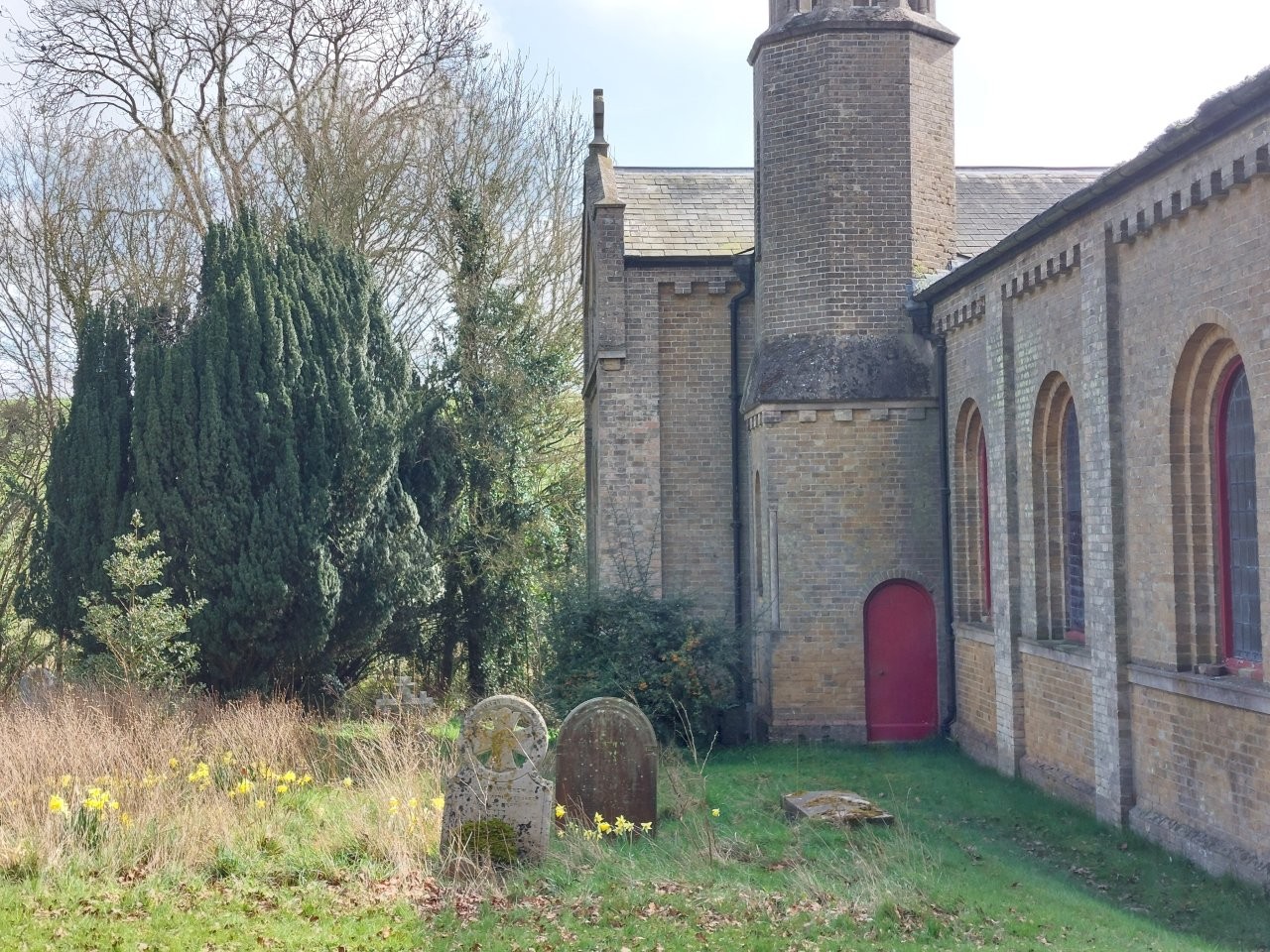
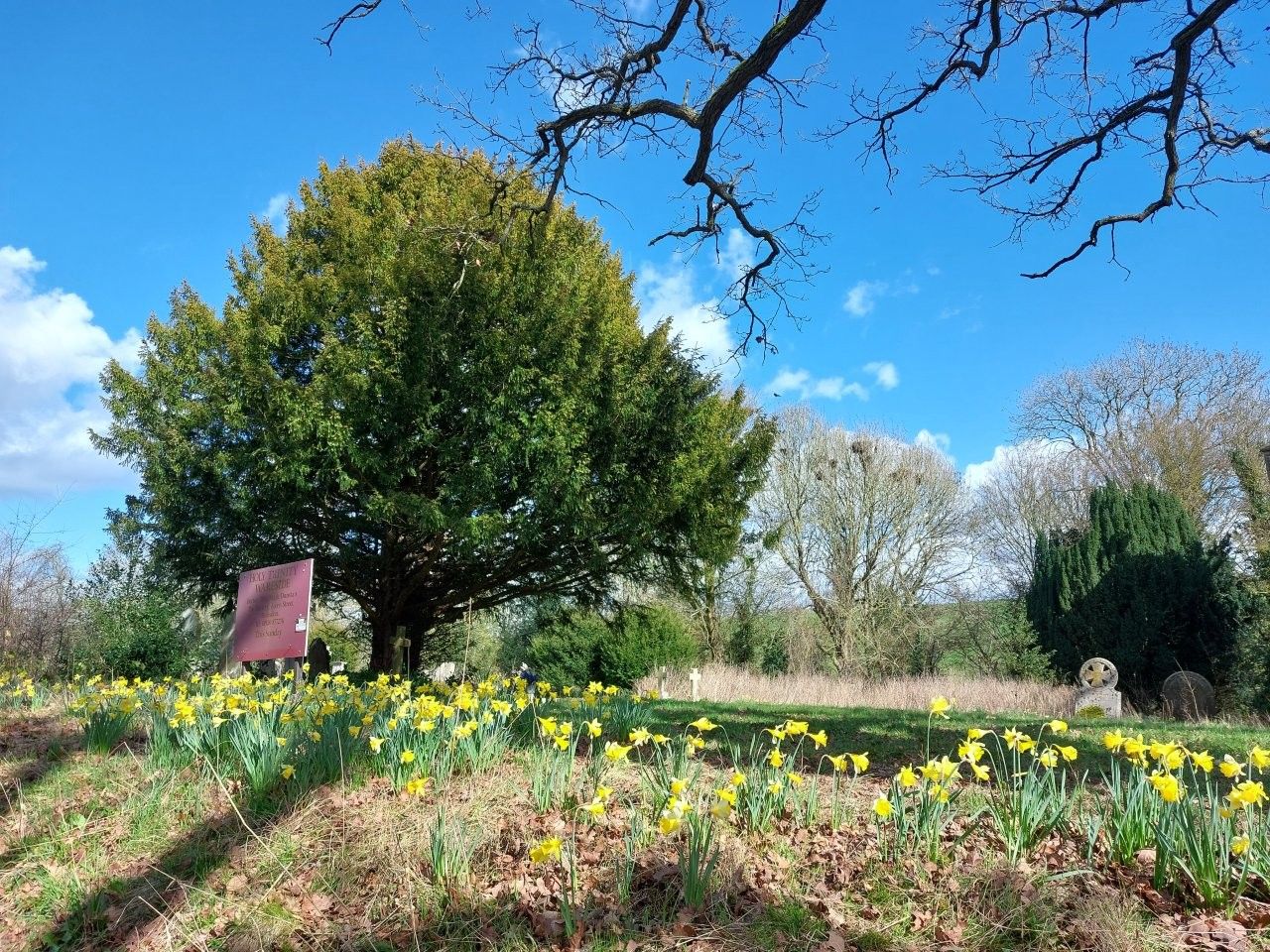
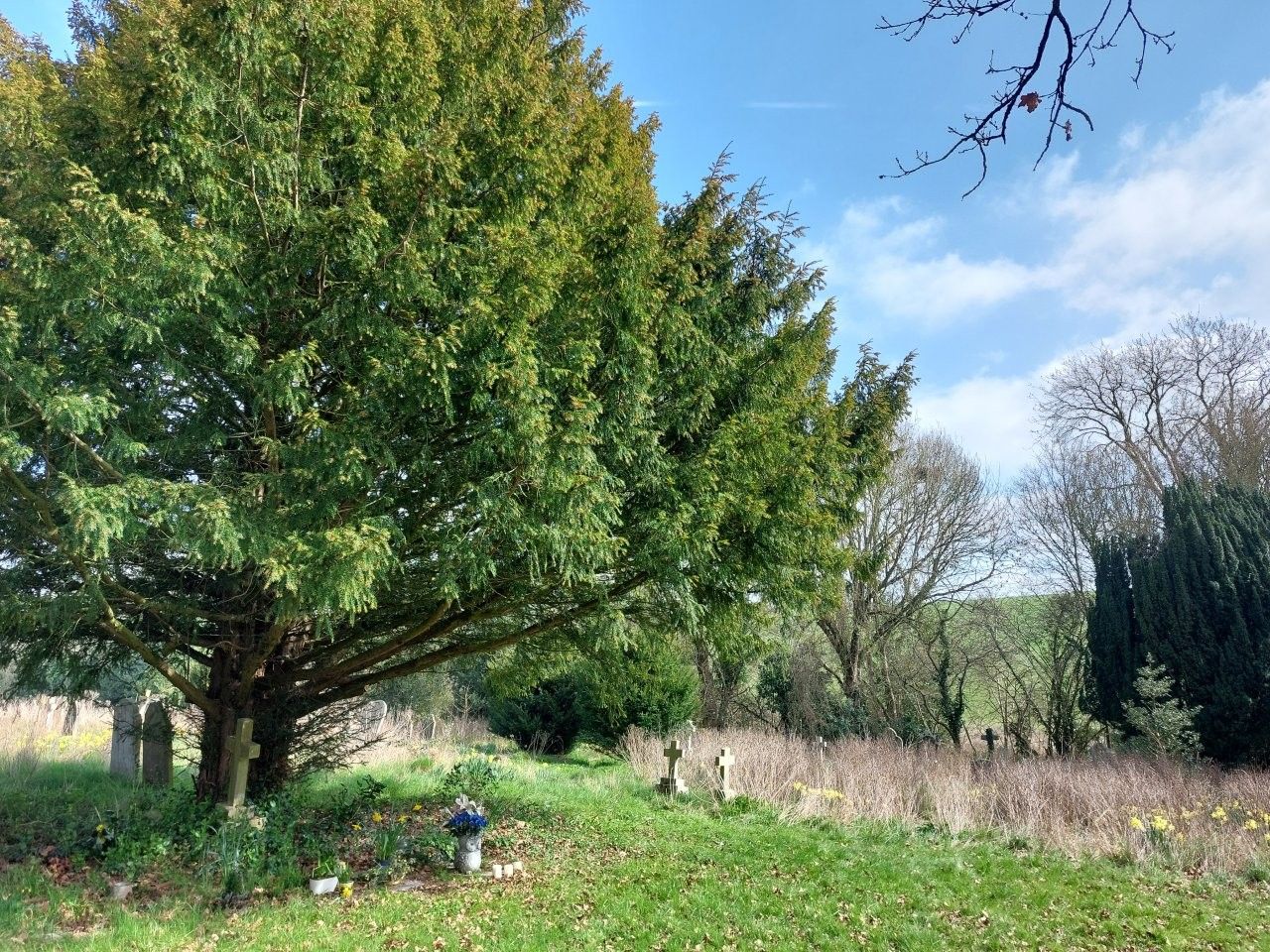
There is a particular kind of stillness that settles over Wareside Church as the late afternoon sun begins its slow descent. If you stand with your back to the church and look north across the rows of headstones, your eyes are almost inevitably drawn to the deep, brooding green of our yew trees. They stand like silent sentinels, their dense canopies offering a stark contrast to the bright yellow of the daffodils currently swaying in the breeze.
At the recent churchyard tidy-up event, I was asked a question I often hear from visitors: “Why is there always a yew tree in a churchyard?”
It’s a wonderful question, and it made me think of writing a series of blogposts exploring the trees and plants that call Wareside churchyard home. And where better to start than with the mysterious, ancient, and deeply symbolic yew?
A Legacy Older Than the Walls
Wareside Church is only 185 years old. That’s young as far as churches are concerned. The buildings in Hunsdon and Widford are much older, and their thick flint walls exude a sense of permanence. Yet, for many churches across Britain like them, the yew trees in the grounds are actually older than the building itself. Research suggests that approximately 500 yews in England and Wales were planted before their accompanying churches were even built.
In the ancient, pre-Christian world of the Celts and Druids, the yew was a sacred tree. Because of its incredible longevity, it was seen as a symbol of eternity (some specimens in the UK are estimated to be over 3,000 years old). It is a tree that never seems to die; even when the center of the trunk rots away, the yew can send down internal roots to create a new heart, effectively regenerating itself from within.
When the first Christian missionaries arrived, they often chose sites that were already considered holy by the local people (though the locals wouldn’t have used that word). By building churches next to these ancient yews, they were able to bridge the gap between old traditions and the new faith, repurposing the tree’s symbolism of “everlasting life” to represent the hope of eternal life in Christ.
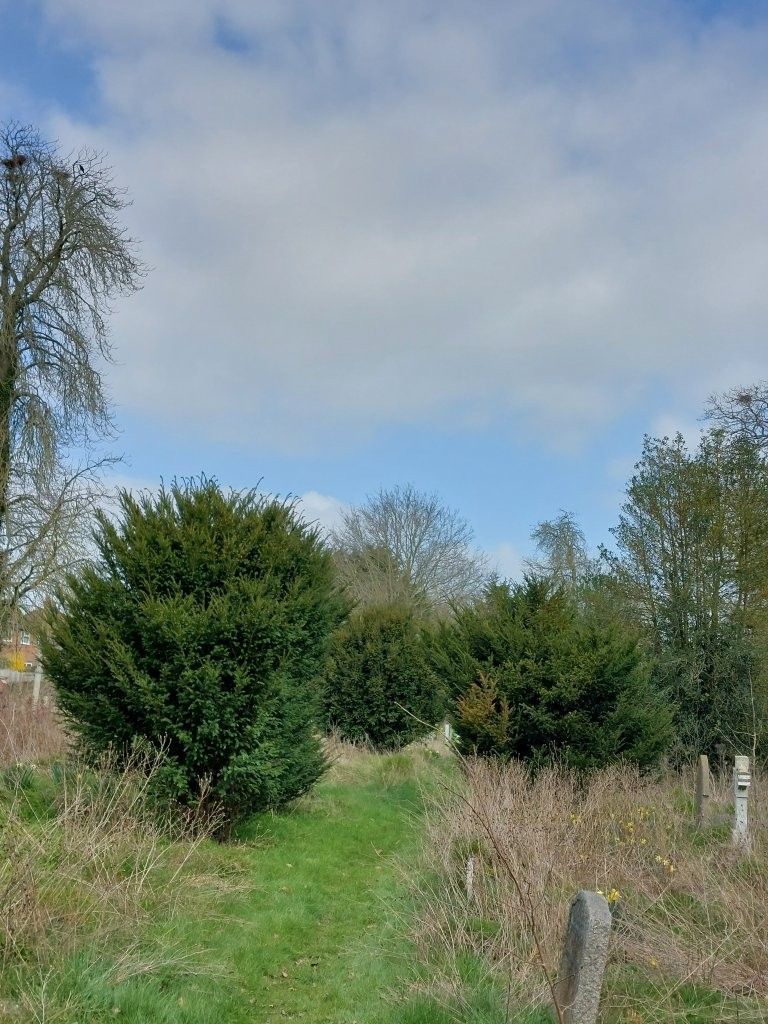
But Why the Churchyard Specifically?
Beyond the spiritual and the ancient, there may be some very practical and slightly more “earthly” reasons why yews became such a staple of the English churchyard. It has been suggested that there was a strategic plan behind the greenery.
One of the most common theories is surprisingly practical: livestock. In centuries past, the churchyard was often the only fenced-off piece of land in a village. Because yew needles and berries are highly poisonous to cattle and sheep, farmers were careful to keep their animals away. Planting yews in the churchyard meant the trees were protected from the nibbling of livestock, and conversely, the presence of the poisonous trees discouraged locals from letting their cows wander among the graves.
There’s also the military history to consider. In the Middle Ages, every able-bodied man was required to practice archery. The wood of the yew is legendary for its combination of strength and flexibility, making it the perfect material for the English longbow. Some believe that yews were grown in churchyards to ensure a steady supply of local timber for the village’s defence – safe from the hungry mouths of roaming animals.
A Symbol of Hope and Resurrection
As a faith community, perhaps we might look at the yew through a more theological lens. Wareside Church strives to be a place of welcome and renewal, as anticipated by the diocesan vision, Living God’s Love. The yew embodies this perfectly.
Because it is an evergreen, the yew remains vibrant and full of life even in the dead of winter when every other tree looks skeletal. For generations of Wareside residents, seeing that splash of green against a grey winter sky served as a reminder that life persists, even in times of darkness. It is a living metaphor for the Resurrection. We plant them near our departed loved ones not as a sign of mourning, but as a testament to the hope of eternal life.
Noticing the Details at Wareside
If you take a moment to look closely at our yews next time you visit a grave or for one of our Sunday services, you’ll notice the incredible texture of the bark. It’s a tapestry of reddish-browns and deep purples, peeling away in thin flakes like old parchment. In late summer and autumn, the trees produce bright red “arils”: fleshy, berry-like structures that birds love, though we humans must be careful to stay away!
A Place for Reflection
When life feels a bit too fast – when the inbox is full and the diary is overflowing – a few minutes in the open countryside or in a tranquil space like our churchyard can reset the soul.
We are so grateful for our churchyard volunteers who help maintain our grounds. It’s no small task to care for such a space, and it is their hard work which keeps visitors safe and the yard accessible. Whether you come for a moment of quiet prayer at the graveside or a joyful community gathering, we hope the beauty of God’s creation in this place will be a blessing to you.
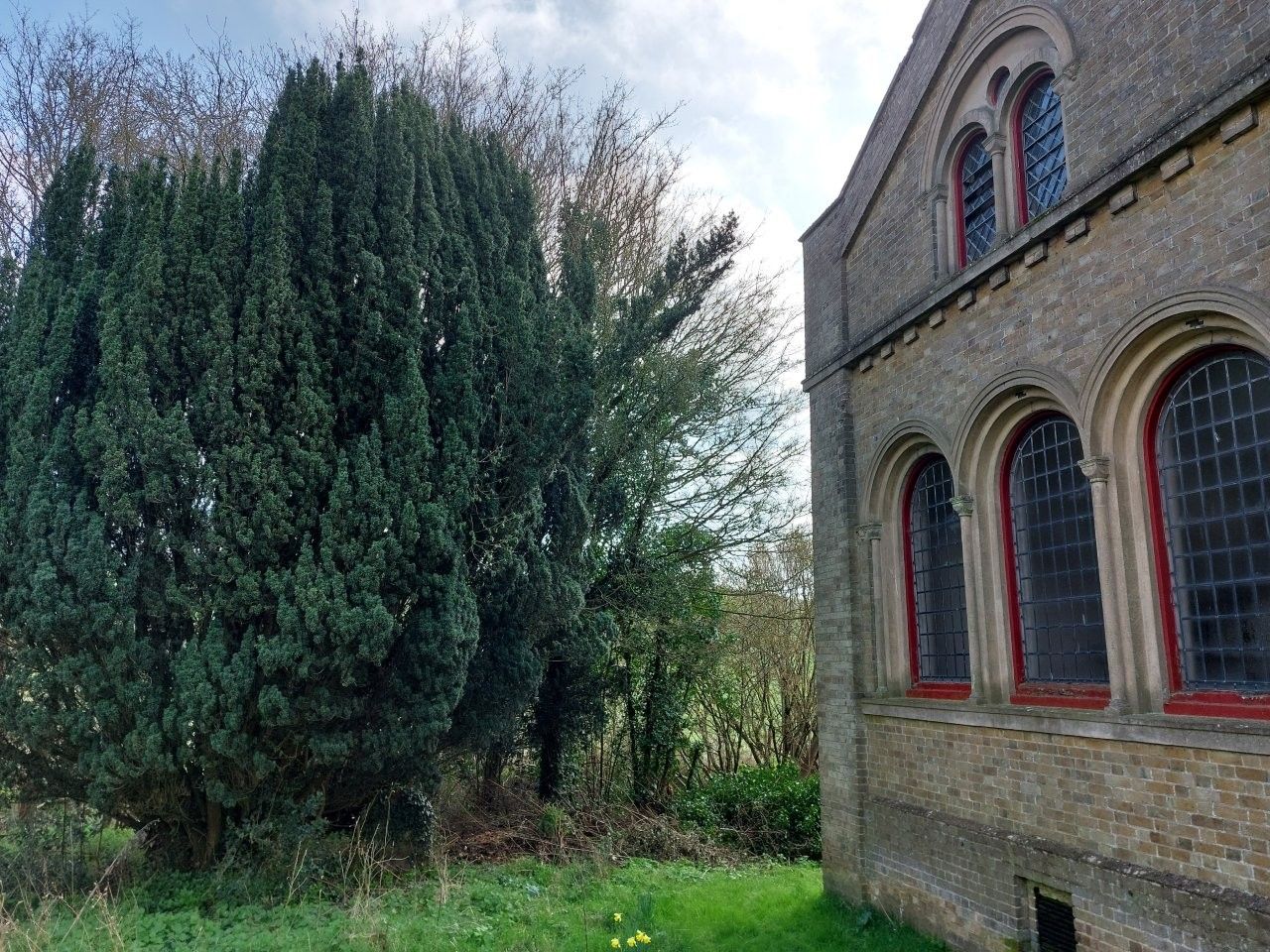
Join Us in the Churchyard
This post is just the beginning of our journey through the flora of Wareside. We have so many wonderful species to cover: from snowdrops which have just passed to the mighty horse chestnut which towers over the road. But the yew will always hold a special place as the “grandfather” of the churchyard.
We invite you to come and see for yourself. Whether you’re a long-time member of our congregation or someone who just enjoys a peaceful walk through the village, our gate is never locked. And if you would like to get involved in our next community clean-up or outdoor event, make sure you follow our social media accounts (Facebook, Instagram or Twitter) or register with us to receive occasional email updates.
Do you have a favourite tree in our churchyard? Or perhaps a memory of a particular season at Wareside Church? We’d love to hear from you. Our community is built on these shared stories and connections.
Right now, we’re looking forward to the Easter celebrations, with the solemnity of Maundy Thursday, the pain of Good Friday and the joy of Resurrection Sunday. After that, keep an eye on the blog for the next instalment in our “Trees of Wareside” series. We’ll be looking at the majestic Oak that greets visitors as they arrive at the foot of the church path. Until then, as you ponder the evergreen yew, may you know the peace of Christ and the hope of his resurrection.
Blessings,
Mark Dunstan
Rector, Wareside Church
Comments are closed